






LED Tubes
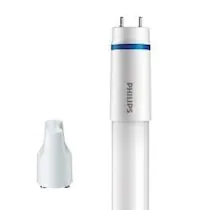
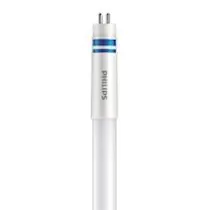
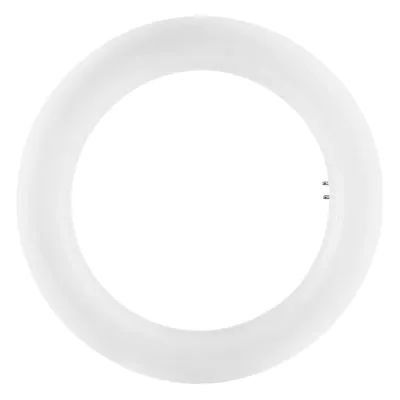
LED tubes are the sustainable and energy-efficient replacers for traditional fluorescent tubes. They have a long lifespan and low maintenance costs. LED tube lights are used in many different settings, such as barns or garages, as well as in offices, schools, retail outlets and industrial environments. At Any-Lamp, you can choose from LED tubes with a T8 (G13) socket, T5 (G5) socket or circular LED tubes with a T9 (G10q or GR10q) socket. Installation is very straightforward, though it does depend on the type of LED light tube you are placing and the type of fixture: compatible with a conventional ballast (EM + LED starter), electronic ballast (HF) or Mains (230V). Check out more (installation) tips on LED tube lights...

 Every bulb or fixture has an energy efficiency class A to G. Energy label A is the most efficient and G the least. LED lighting is the most sustainable lighting technique. Even if a LED bulb is rated E or lower, they still save 70% of energy compared to conventional lighting with the same energy label. Why is it the same label then? To motivate LED brands to get even more durable.


LED tubes are the sustainable and energy-efficient replacers for traditional fluorescent tubes. They have a long lifespan and low maintenance costs. LED tube lights are used in many different settings, such as barns or garages, as well as in offices, schools, retail outlets and industrial environments. At Any-Lamp, you can choose from LED tubes with a T8 (G13) socket, T5 (G5) socket or circular LED tubes with a T9 (G10q or GR10q) socket. Installation is very straightforward, though it does depend on the type of LED light tube you are placing and the type of fixture: compatible with a conventional ballast (EM + LED starter), electronic ballast (HF) or Mains (230V). Check out more (installation) tips on LED tube lights...
What are LED tubes and how do they work?
LED tubes are an energy-efficient alternative to traditional fluorescent tubes; you can save between 50% and 60% on average. The difference is in the technology they use. Traditional fluorescent tubes operate via gas discharge (mercury) and emit light in all directions (360°). LED tube lights use LED chips that emit light directed downwards, often at a beam angle of 120° to 160°. This makes them much more efficient in terms of energy consumption and light distribution.
How to replace fluorescent tubes with LED?
There are two ways to do this, depending on whether you are using your old fluorescent tube fixture or installing a completely new fixture.
1. How to fit a LED light tube into your current fixture with ballast?
If you have a fluorescent fixture with an electronic ballast (HF) or a conventional ballast (EM), you can replace your fluorescent tube with a plug-and-play LED tube of the same compatibility (read more below). Please bear the following in mind:
- HF LED tubes - There is just one step: remove the fluorescent tube from your fixture and install the LED light tube.
- EM LED tubes - Supplied with a LED starter. You should replace both your old fluorescent tube and your old starter for optimal performance.
- UN LED tubes - These light sources are suitable for use in an electronic ballast or in a conventional ballast with a starter.
You achieve the best efficiency with a Mains (230V) LED tube. PLEASE NOTE: you must modify the fixture by removing the ballast!
2. How to install a LED tube in a LED fixture?
If you are installing a LED fixture or you already have one, you can only use Mains (230V) LED tubes. Installation is the same as for a standard fluorescent fixture: slide the LED tube light into the fixture and turn it a quarter turn.
For a new lighting installation, you can also opt for an LED batten. These offer extra installation convenience and flexibility thanks to features such as CCT, multi-wattage, sensors and/or through-wiring. LED panels are ideal for offices and schools.
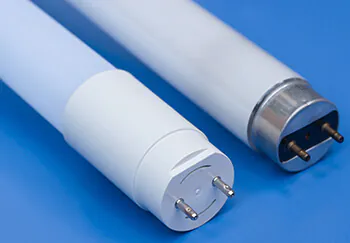
Is this T5 or T8? Here is how you recognise the tube you have ...
The difference is visible in tube diameter and socket. A T8 tube has a diameter of 26 mm and has a 2-pin G13 socket. These pins are spaced 13 mm apart. A T5 tube light has a diameter of 16 mm and has a G5 socket: 2 pins that are placed 5 mm apart.
How do you choose the right replacement?
To install a LED tube that delivers the same performance as its fluorescent predecessor, you need to pay attention to three specifications:
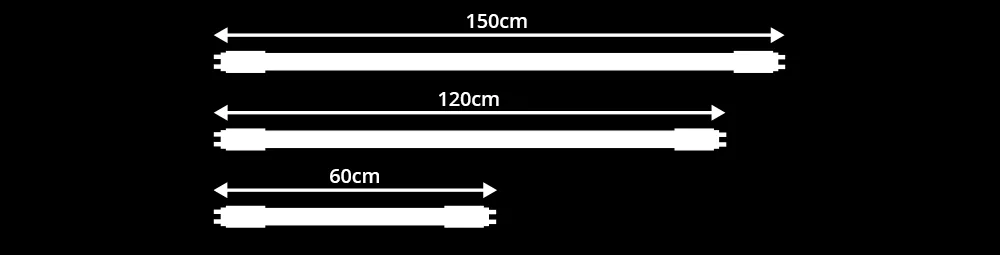
- Length - Pick the same length (e.g. LED tube light 60cm). Measure a LED or fluorescent tube from end to end, including the pins.
- Wattage - Our LED tubes state the wattage of the fluorescent tube they replace in the title. Alternatively, use the ‘Replaces (Watt)’ filter.
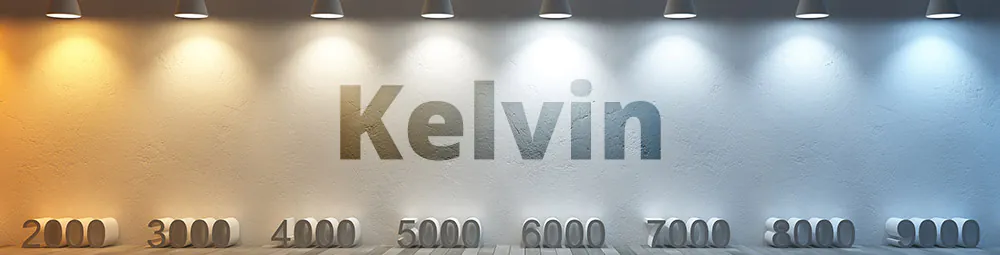
- Light colour - Common options are 3000K, 4000K and 6500K, but there are other options available.
What is the difference in lumens per watt between budget and professional LED tubes?
Cheaper LED tube lights offer 90–110 lm/W efficiency, whilst professional tubes offer 140–170 lm/W or even higher. This difference affects energy consumption, heat generation and lifespan. Want to know more about the output or efficiency of our tubes? Here is the availability by brand:
How do you connect a LED tube?
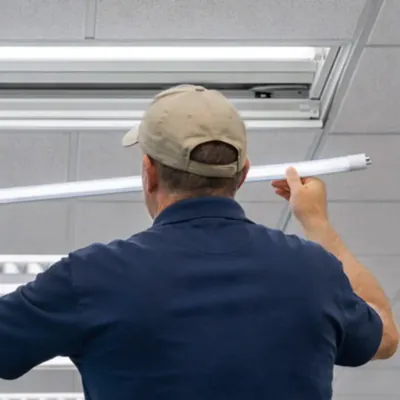
Follow the step-by-step guide for the safe installation of your LED tube (EM, HF or UN) in your fluorescent fixture:
- Switch off the power and the fuse.
- Remove the cover from the fluorescent fixture.
- Rotate your fluorescent tube 90 degrees forwards.
- Pull the tube downwards out of the holder.
- For a conventional ballast: remove the starter and insert the LED starter.
- Push the LED tube light into the holder.
- Rotate the light source 90 degrees backwards.
- Remount the cover on the fixture.
- Switch on the power and fuse, and your lighting is ready.
FAQ for LED tube installations:
Achieve the best results in professional environments as an installer!
If you remove the ballast, the fixture’s UKCA conformity may change (former CE conformity). In professional environments, this must be properly documented (re-certification or documentation).
Ballast-compatible tubes are quicker to install because they can be replaced on a one-to-one basis, but the ballast remains a bottleneck (point of failure) in the long run (it becomes obsolete and causes additional energy loss). Mains (230V) is more efficient and is virtually maintenance-free.
Yes. With large numbers of LED tubes or large installations (e.g. in a warehouse or industrial hall), a high power factor (>0.9) helps prevent power factor distortion and additional strain on the installation. In this case, an integrated LED fixture may be an even better solution.
Certainly in offices, shops and educational settings. A low SDCM (≤3) ensures that multiple tubes look visually identical. At higher SDCM values, colour differences may become visible, particularly if they are placed close together or in a line.
Standard LED tubes are not designed for use in fixtures with emergency batteries. Emergency lighting fixtures often require specific compatibility. There are LED tubes suitable for emergency systems, but this must be explicitly stated. We recommend opting for an integrated LED solution for emergency lighting.
You can have up to 5 products in the comparison list.